· Use Cases · 3 min read
Audio Description in Education: Making E-Learning Accessible to All Students
Educational videos without audio description exclude visually impaired students. Here is why and how educational institutions should add AD to their learning content.

The shift to digital and hybrid learning has made video a primary educational tool. Lecture recordings, instructional videos, lab demonstrations, virtual field trips, video content is now central to the educational experience at every level.
But for students who are blind or have low vision, much of this content is inaccessible. An instructor’s whiteboard work, a diagram in a science video, a demonstration in a skills workshop - without audio description, these visual elements are invisible.
The Regulatory Landscape
Educational institutions face particularly strong accessibility mandates:
United States
- ADA Title II (April 2026): Public universities and schools must meet WCAG 2.1 AA, including audio description for pre-recorded video
- Section 504 of the Rehabilitation Act: Requires equal access to educational programs and activities
- Section 508: Federal technology must be accessible, affecting institutions receiving federal funding
European Union
- European Accessibility Act: Applies to e-learning platforms and educational technology
- National disability laws: Each EU country has additional requirements for educational accessibility
Australia
- Disability Discrimination Act: Requires reasonable adjustments in education
- Disability Standards for Education 2005: Specifically addresses accessible educational materials
Why Education Needs Audio Description
The Content Challenge
Educational video content is uniquely visual:
- Mathematical equations written on whiteboards or shown in slides
- Scientific diagrams illustrating biological processes, chemical structures, or physical principles
- Maps and charts in geography, history, and social science
- Technical demonstrations in engineering, medicine, and trades
- Art and design content that is inherently visual
- Lab procedures requiring visual observation
Without AD, a visually impaired student misses information that is essential for learning, putting them at a direct educational disadvantage.
The Scale Challenge
A single university may produce thousands of hours of video content each semester:
- Recorded lectures across all departments
- Lab demonstration videos
- Tutorial and supplementary content
- Library and archival recordings
- Student-facing administrative videos
Manual AD for this volume is impractical. Most institutions either provide no AD at all or offer it only on request, a reactive approach that delays access and places the burden on disabled students to identify and request accommodations.
Implementing Audio Description in Education
Prioritization
Not all content requires the same approach:
Tier 1: Critical (Must have AD)
- Core lecture recordings for required courses
- Lab and demonstration videos
- Assessment-related content
- Orientation and onboarding materials
Tier 2: Important (Should have AD)
- Supplementary lecture content
- Library and research resources
- Student services videos
Tier 3: Beneficial (Nice to have AD)
- Marketing and recruitment videos
- Event recordings
- Historical archives
Production Approaches
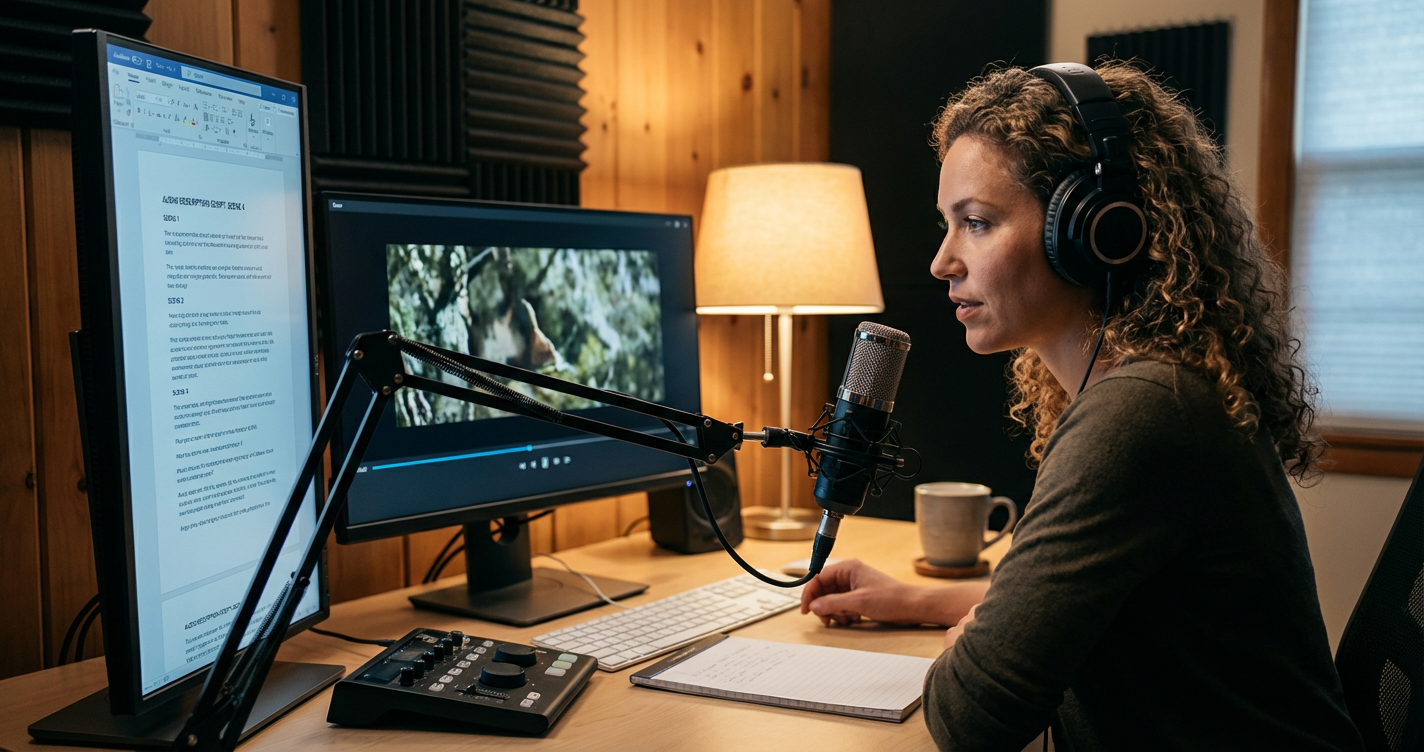
AI-Powered AD is particularly well-suited for educational content because:
- Volume is high and ongoing (new content every semester)
- Budget constraints are real (educational institutions operate on tight margins)
- Content is often straightforward (lectures, demonstrations) rather than artistically complex
- Turnaround needs to be fast (content should be accessible when published, not weeks later)
Integration with LMS
Audio description should be delivered through the institution’s Learning Management System (Canvas, Moodle, Blackboard) alongside existing accessibility features like captions and transcripts.
Best Practices
- Make AD proactive, not reactive: Generate AD for all video content as part of the production workflow, not in response to accommodation requests
- Include mathematical and technical content: Ensure AD covers equations, diagrams, and technical notation, as these are often the most critical visual elements
- Train instructors: Help faculty understand what AD is and why their visual content needs verbal description
- Use consistent terminology: Establish discipline-specific description conventions for technical content
- Test with students: Involve visually impaired students in evaluating AD quality for educational content
The Bottom Line
Education is a fundamental right, and accessible education requires accessible content. As video becomes increasingly central to teaching and learning, audio description is not optional, it is an essential component of educational equity. AI-powered solutions make it feasible to achieve comprehensive AD coverage even within the budget constraints that educational institutions face.
Making your educational content accessible? Try the Visonic AI audio description generator. It’s affordable, automated AD designed for institutions with large video libraries.