· Industry · 3 min read
Adding Audio Description to Your Entire Back-Catalog
Streaming platforms have thousands of hours of content without audio description. Here is a practical approach to making an entire content library accessible at scale.

Every major streaming platform faces the same challenge: a content library with thousands of hours of video, and a growing regulatory and consumer expectation that all of it should include audio description. The math with traditional AD methods simply does not work. Here is how to approach the problem strategically.
The Scale of the Problem
Consider a mid-size streaming platform with 5,000 hours of content:
- Current AD coverage: Typically 5–15% of the library
- Gap: 4,000+ hours without AD
- New content added monthly: 50–200 hours
- Manual AD capacity: A typical provider can deliver 20–40 hours per month
At that rate, achieving full library coverage would take 8–16 years, by which time the library would have grown further. This is why a different approach is needed.
Step 1: Audit and Prioritize
Not all content needs AD at the same time. Prioritize based on:
Tier 1: Immediate (Months 1–3)
- Top 100 most-watched titles: These serve the largest audience and offer the most immediate impact
- New releases: All new content should have AD from launch going forward
- Content in regulated markets: Titles served in EU (EAA), US public entities (ADA), or UK (Ofcom) markets
Tier 2: Near-term (Months 3–6)
- Catalog titles in the top 500 by viewership
- Content marketed to family audiences (higher likelihood of viewers with disabilities)
- Award-nominated or critically acclaimed content (reputational value)
Tier 3: Comprehensive (Months 6–18)
- Remaining catalog content by viewership, working from most-watched to least
- Archival content being prepared for re-release or syndication
Step 2: Choose the Right Technology Mix
Different content may warrant different approaches:
AI Audio Description (Primary, 85%+ of content)
Best for: Series episodes, documentaries, reality TV, news content, educational content, most films
- Fastest processing speed
- Lowest cost per minute
- Consistent quality at scale
- Multi-language capability
Human-Reviewed AI (Selective, 10% of content)
Best for: High-profile originals, content with complex visual storytelling, content in culturally sensitive areas
- AI generates initial descriptions
- Human reviewers refine and enhance
- Combines speed of AI with human judgment
Traditional Manual AD (Minimal, 5% of content)
Best for: Prestige titles, award-contending content, content with heavy visual symbolism
- Expert human describers
- Highest quality ceiling
- Slowest and most expensive
Step 3: Build the Pipeline
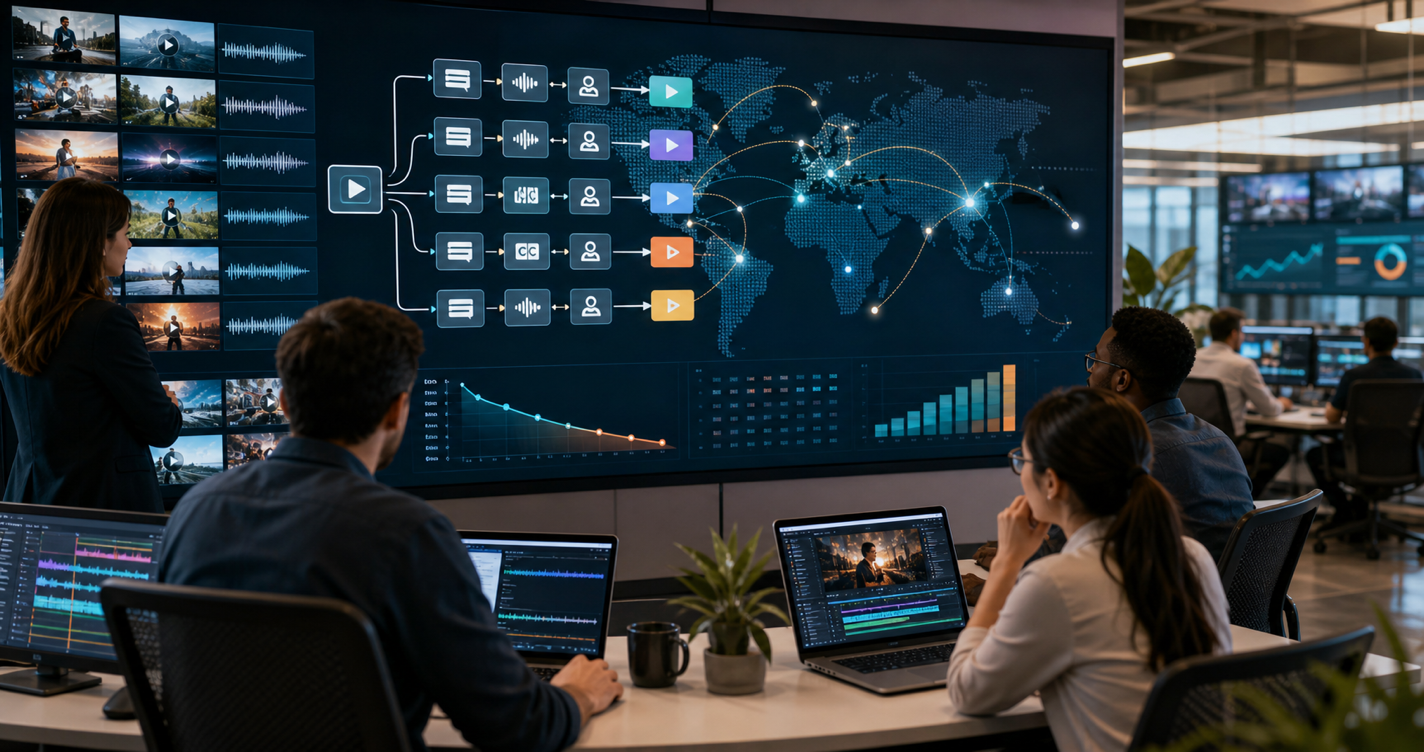
A sustainable AD pipeline treats audio description as a standard step in the content delivery workflow, not a separate project.
Ingest
When content enters your system, automatically queue it for AD generation alongside other localization tasks (subtitles, dubbing, metadata).
Processing
AI analyzes the content and generates descriptions. This can happen in batch (for back-catalog) or in real-time (for new content).
Quality Assurance
Automated checks verify timing, completeness, and technical compliance. Flag edge cases for human review.
Delivery
AD tracks are delivered as a standard component of the content package, available to viewers through the platform’s accessibility settings.
Monitoring
Track AD coverage metrics alongside other content metrics. Report on coverage by genre, region, and language.
Step 4: Measure and Report
Key metrics to track:
- AD coverage rate: Percentage of total library hours with AD
- New content AD rate: Should be 100% for all new releases
- Viewer adoption: How many viewers activate AD
- Quality feedback: User ratings and complaints related to AD
- Regulatory compliance: Coverage against applicable requirements by territory
The Business Case
Beyond compliance, audio description serves a real audience. An estimated 2.2 billion people globally have some form of vision impairment. Many are potential subscribers.
Platforms that offer comprehensive audio description:
- Expand their addressable market
- Reduce churn among viewers who need accessibility features
- Differentiate from competitors with limited accessibility
- Future-proof against tightening regulations
- Improve SEO (AD transcripts create searchable text content)
Getting Started
The most important step is starting. Every week of delay means more content enters the library without AD, increasing the backlog. AI-powered audio description makes it possible to begin at scale today, and to make meaningful progress toward full library accessibility within months, not years.
Ready to start processing your back-catalog? Try the Visonic AI audio description generator. Upload your content and generate AD at scale.