· Technology · 4 min read
Long-Form Video Understanding: Behind AI Audio Description
Understanding a 2-hour film requires AI capabilities far beyond image recognition. Here is how long-form video understanding works and why it is essential for generating quality audio descriptions.
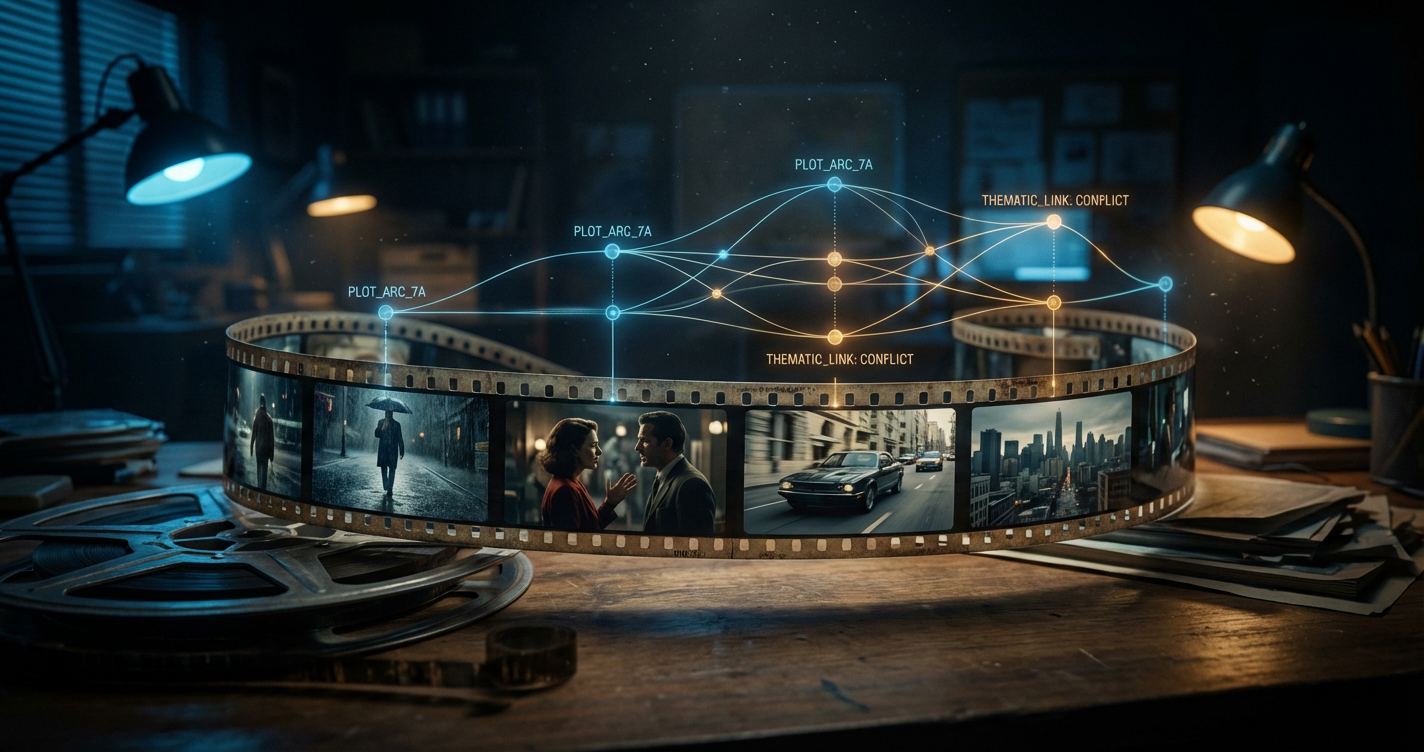
A movie is not a collection of disconnected frames. It is a narrative that unfolds over two hours, with characters that evolve, plots that twist, and visual motifs that carry meaning. Understanding a film well enough to describe it for a visually impaired audience requires something that has eluded AI for years: long-form video understanding.
The Challenge of Long-Form Video
Most AI video models were designed for short clips, 10 to 30 seconds of action. Processing a 90-minute film requires capabilities of a fundamentally different order:
Scale
A two-hour film at 24 frames per second contains approximately 172,800 frames. Even with aggressive sampling, the model must process thousands of images while maintaining coherence across the entire duration.
Memory
The model must remember that a character introduced in the opening scene is the same person appearing 90 minutes later in different clothing, a different location, and a different emotional state. This requires long-range memory that spans the entire video.
Context
A prop shown briefly in act one may become critical in act three. A background detail may foreshadow a plot development. The model must maintain a running understanding of what has happened and what might be significant.
Narrative Structure
Films follow narrative conventions: setup, confrontation, resolution. The model must understand not just what is happening, but where in the story it is happening. The same visual event (a door closing) has different narrative weight at the beginning versus the climax of a film.
How Long-Form Video Understanding Works
Hierarchical Processing
Rather than processing every frame equally, modern LFVU systems work hierarchically:
- Frame sampling: Select representative frames at regular intervals and at scene boundaries
- Scene-level analysis: Process clusters of frames as coherent scenes
- Sequence-level reasoning: Connect scenes into narrative sequences
- Film-level understanding: Maintain a global representation of the entire work
Token Compression
Video generates enormous amounts of data. LFVU models use compression techniques to reduce this to manageable representations:
- Spatial compression: Reduce each frame to a compact visual token
- Temporal compression: Merge redundant information across consecutive frames
- Attention mechanisms: Focus computational resources on visually significant moments
Context Windows
Recent advances in transformer architectures have dramatically expanded the context windows available to video models. Where earlier models could handle a few hundred tokens, modern systems can process millions of tokens, enough to represent an entire feature film.
Applications Beyond Audio Description
Long-form video understanding enables a range of applications across the media industry:
Content Summarization
Generate accurate summaries of entire films, series episodes, or documentaries, useful for content catalogs, marketing, and editorial workflows.
Intelligent Chaptering
Automatically divide long-form content into meaningful chapters with descriptive titles, improving navigation and discovery on streaming platforms.
Highlight Detection
Identify the most significant moments in long-form content, crucial for sports highlights, trailer generation, and social media clips.
Content Search
Enable natural language search across video archives: “Find all scenes where the detective examines evidence” or “Show me every outdoor scene in this series.”
Metadata Generation
Automatically generate rich metadata for every scene (characters present, locations, actions, mood, dialogue topics) making content libraries searchable and monetizable.
Why It Matters for Audio Description
Audio description requires understanding at every level of the hierarchy:
- Frame level: What objects and people are visible right now?
- Scene level: What is happening in this scene? What is the mood?
- Sequence level: How does this scene connect to what came before?
- Film level: Is this moment significant to the overall narrative?
A system that only understands individual frames will produce descriptions like “A man stands in a room.” A system with long-form video understanding will produce “Detective Morrison returns to the crime scene, his expression suggesting he has noticed something everyone else missed.”
The difference between these two descriptions is the difference between accessibility and genuine inclusion.
The State of the Technology
Long-form video understanding has advanced rapidly in 2024-2025:
- Video-language models now process hours of content in a single pass
- Temporal reasoning benchmarks show steady improvement in narrative comprehension
- Real-world deployment is happening at scale for the first time
For audio description specifically, these advances mean that AI can now understand a film well enough to describe it with the kind of contextual awareness that was previously only possible with human writers. The technology is not perfect (complex visual metaphors and culturally specific references remain challenging) but it has crossed the threshold of practical utility.
The next frontier is making this technology faster, more affordable, and more widely available so that every piece of video content can be made accessible.
Experience long-form video understanding firsthand. Try the Visonic AI audio description generator. It delivers contextually aware AD for films, series, and long-form content.