· Ari Surana · Guides · 12 min read
AI for Audio Description: The Complete Guide for 2026
How AI audio description works, where the technology stands today, and why regulatory deadlines make it essential for any organization producing video at scale.
A skilled audio describer takes 30 to 60 minutes to script five minutes of video. That’s a 6-to-12x time ratio before you even get to voice recording, quality review, and audio mixing. For a streaming platform sitting on 10,000 hours of back catalog, describing it all manually would take a team of describers working full-time for years. Decades, realistically.
Meanwhile, the ADA Title II web accessibility rule takes effect in April 2026 for large US public entities. The European Accessibility Act kicked in June 2025. Ofcom’s audio description quotas keep climbing. The regulatory pressure is accelerating, and the supply of trained human describers isn’t keeping pace.
AI audio description isn’t replacing human describers. It’s the only realistic way to close the gap between what’s required and what’s humanly possible. Tools like Visonic AI use multimodal AI to generate broadcast-quality descriptions from video, handling the drafting, timing, and multi-language output so that human describers can focus on review and creative refinement.
What Is Audio Description?
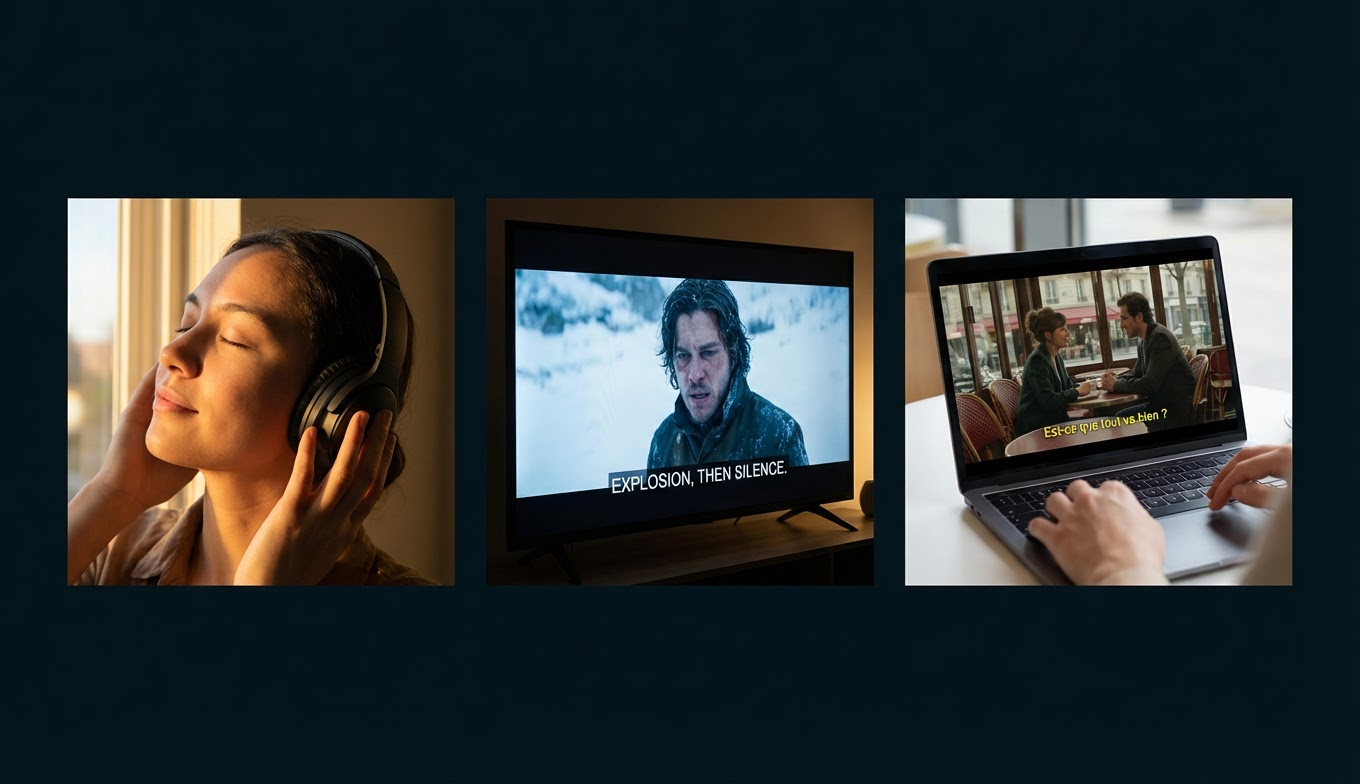
Audio description (AD) is a narrated track that describes the visual elements of video content (actions, expressions, scene changes, on-screen text) for people who are blind or have low vision. It fits into natural pauses in dialogue and sound effects, providing a complete experience without interrupting the original audio.
It’s different from closed captions (which transcribe speech and sounds as text) or subtitles (which translate dialogue). Audio description conveys what you see. According to WCAG 2.1 Success Criterion 1.2.5, audio description for prerecorded video is a Level AA accessibility requirement, meaning it’s not a nice-to-have, it’s a standard.
Globally, 2.2 billion people live with some form of vision impairment. In the US alone, over 32 million Americans experience significant vision loss. And according to a survey by the American Council of the Blind, 75.3% of blind and low vision respondents say they need significantly more audio-described content than what’s currently available.
For a deeper introduction, see our complete guide to audio description.
How AI Audio Description Works
Traditional audio description requires a human scriptwriter to watch the video, identify what matters visually, write a script that fits between dialogue gaps, and then a voice actor or text-to-speech system to narrate it. AI changes the first three steps.
Modern AI audio description uses multimodal vision-language models (VLMs), AI systems that can process both video and text simultaneously. Here’s what the pipeline looks like:
1. Video analysis. The AI processes video frames (or keyframes sampled at intervals) through a vision encoder. It identifies people, objects, actions, spatial relationships, and scene composition.
2. Context integration. The model ingests the existing audio track (dialogue, subtitles, sound effects) so it knows what information is already conveyed through sound. This prevents the description from repeating what the viewer can hear.
3. Description generation. A large language model generates natural-language descriptions timed to fit in dialogue gaps. The model applies audio description guidelines: describe what’s visually significant, stay objective, don’t interpret emotions unless they’re unambiguous.
4. Speech synthesis. Text-to-speech converts the script to narrated audio, matched to the appropriate timing in the video.
The key breakthrough came with models like GPT-4V, Gemini, and Claude that can natively process visual input. The LLM-AD system demonstrated in 2024 that GPT-4V could generate audio descriptions by combining visual frame analysis with textual context from subtitles, including a tracking-based character recognition module for consistent identification across scenes.
In 2025, the VideoA11y project at CHI 2025 pushed further, creating a dataset of 40,000 video descriptions and demonstrating that MLLM-generated descriptions could match trained human quality across multiple evaluation dimensions.
For more on the multimodal AI technology, see how multimodal AI enables broadcast-quality audio description.
How Good Is AI Audio Description Today?
This is where honesty matters. The technology has improved dramatically, but it has specific strengths and weaknesses that anyone evaluating it should understand.
What the research shows
The most rigorous evaluation to date is the VideoA11y study, presented at CHI 2025 in Yokohama. Researchers tested AI-generated descriptions across 15 video categories with 347 sighted participants and 40 blind and low vision users, compared against 7 professional describers.
The result: AI descriptions outperformed novice human annotations and were comparable to trained human annotations in clarity, accuracy, objectivity, descriptiveness, and user satisfaction.
That’s a meaningful benchmark. But “comparable to trained humans on average” hides important nuances.
Where AI excels
AI is consistently good at objective, factual descriptions: who’s in the scene, what objects are present, physical actions, spatial arrangement, scene transitions. For content with clear visual information (documentaries, news, educational videos, corporate content) AI produces reliable descriptions.
AI also excels at consistency and scale. It doesn’t get tired, doesn’t forget a character’s name, and can process content in minutes rather than hours.
Where AI struggles
Research from the YouDescribe project at ACM 2025 identified specific failure modes:
- Character misidentification and hallucination. AI systems sometimes fabricate visual details that aren’t present in the scene, or confuse one character for another.
- Verbose narration. AI tends to over-describe, producing text that’s too dense to fit in dialogue gaps or that overwhelms rather than assists the viewer.
- Narrative flow. Maintaining coherent storytelling across scenes (understanding dramatic tension, emotional subtext, and what’s narratively significant) remains difficult for AI.
- Cultural and emotional nuance. Interpreting culturally specific visual cues, subtle facial expressions, or emotionally charged moments still requires human judgment.
A 2026 study on VLM-based quality rating found that while AI can rate description quality at a level approaching expert benchmarks, its justifications lack the specificity needed to guide actual improvement. Human feedback still generates more actionable insights.
The honest assessment
AI audio description in 2026 is production-ready for many content types, particularly when combined with human review. It’s not yet reliable enough for fully automated deployment on complex narrative content (feature films, prestige drama) without a human in the loop.
For organizations facing compliance deadlines and large content backlogs, this changes the game. Producing an AI draft that a human describer refines is dramatically faster and cheaper than starting from scratch.
The Economics: Why Manual AD Can’t Scale
The math behind the audio description bottleneck is straightforward and unforgiving.
According to the Audio Description Project at ACB, a human writer needs 30 to 60 minutes to create a script for just 5 minutes of program material. That’s before voice recording, review, and final mixing.
Traditional fully-human audio description costs $15 to $30 per finished minute, with complex content like feature films reaching $75 per minute. For a one-hour program:
| Approach | Cost per Hour | Production Time |
|---|---|---|
| Traditional manual (standard) | $900 - $1,800 | 2-5 days |
| Traditional manual (premium) | $2,700 - $4,500 | 3-7 days |
| AI-assisted (human review) | $300-1,200 | Hours |
| Volume hybrid services | ~$132 (at volume rates) | 1-2 days |
A broadcaster with 5,000 hours of back catalog facing a compliance deadline isn’t looking at an accessibility project. They’re looking at a multi-million dollar, multi-year undertaking at traditional rates. Most organizations simply can’t afford universal coverage through manual methods alone.
AI changes this equation by generating initial drafts in minutes rather than hours. With a platform like Visonic AI, you upload a video and receive a complete audio description (scripted, timed, and narrated) that a human describer can then review and refine. The describer’s expertise is focused where it adds the most value (cultural nuance, narrative judgment, quality assurance) rather than on the mechanical work of timing, scene identification, and initial scriptwriting.
This isn’t about replacing human describers. It’s about making their work scalable. For more on the cost comparison, see our detailed analysis: the true cost of audio description: AI vs. manual.
The Regulatory Push: Deadlines You Can’t Ignore
Multiple regulations are converging to make audio description a legal requirement for an expanding range of content and organizations.
United States: ADA Title II (April 2026)
The DOJ’s final rule on web accessibility, published April 24, 2024, requires state and local government web content and mobile apps to conform to WCAG 2.1 Level AA. That includes Success Criterion 1.2.5: audio description for prerecorded video.
The deadline for entities serving populations of 50,000 or more is April 24, 2026. Smaller entities have until April 26, 2027.
This means every city, county, state agency, public university, and school district publishing video content needs audio description. Training videos, public meetings, educational content, promotional materials, all of it.
United States: CVAA (Ongoing expansion)
The 21st Century Communications and Video Accessibility Act requires top broadcast networks to provide audio-described programming, with requirements expanding to additional designated market areas each year. The top five national nonbroadcast networks are also subject to AD requirements, with the list updated in 2024.
European Union: European Accessibility Act (June 2025)
The EAA applies EU-wide accessibility requirements to products and services including TVs, computers, audio and video playback systems, and electronic communications. All EU member states must have transposed the directive into national law.
For a deeper dive, see our European Accessibility Act compliance guide.
United Kingdom: Ofcom Quotas
Ofcom’s Code on Television Access Services sets a ten-year target of 10% of programming with audio description for qualifying broadcast channels, with annual compliance reporting.
The compliance cascade
These regulations don’t exist in isolation. A media company operating globally needs to comply with multiple frameworks simultaneously. A streaming platform serving US, EU, and UK audiences faces ADA, EAA, and Ofcom requirements, each with different scopes and timelines. For our full compliance map, see video accessibility laws: a global compliance map.
AI audio description doesn’t eliminate compliance complexity, but it makes meeting multiple deadlines simultaneously achievable rather than aspirational.
AI and Human Describers: Partners, Not Competitors
There’s a reasonable concern that AI will eliminate audio description jobs. The research suggests the opposite is happening.
The current bottleneck isn’t demand. It’s supply. There aren’t enough trained audio describers to cover the content that needs description. AI doesn’t reduce the need for human expertise; it makes human expertise applicable to far more content.
The YouDescribe platform, run by the Smith-Kettlewell Eye Research Institute, rolled out AI-generated drafts within a human-in-the-loop workflow in 2025. The system generates initial descriptions that human contributors (both experienced describers and trained novices) can review, refine, and approve. The AI handles the mechanical work; humans handle the creative and contextual judgment.
This is the model the research community has converged on. Fully automated AD isn’t sufficient on its own. The technology needs human oversight for quality, cultural sensitivity, and narrative coherence. But AI-assisted workflows let a single describer cover far more content than they could manually.
The practical result: more audio described content, more work for skilled describers, and better quality through the combination of AI consistency and human judgment.
Research tools like DescribePro (2025) are advancing collaborative human-AI workflows further, while ADCanvas (2025-2026) is enabling blind and low vision individuals themselves to create audio descriptions, expanding who participates in the process, not just how it’s done.
Choosing an AI Audio Description Solution
If you’re evaluating AI audio description for your organization, here’s what to consider:
Quality and accuracy
Does the system handle your content type well? Documentary and educational content is generally easier for AI than complex narrative drama. Ask for sample outputs on your actual content, not curated demo videos.
Language support
Does the system support the languages you need? Multilingual audio description is especially challenging because description style varies by language and culture. Visonic AI supports 8+ languages including English, German, French, and Hindi, generating culturally appropriate descriptions in each. See our guide on multi-language audio description.
Human review workflow
How does the system support human oversight? The best solutions provide an editing interface where describers can review and modify AI-generated scripts before final output. Fully automated systems with no review pathway should be evaluated carefully.
Integration with existing workflows
Can the system integrate with your media asset management (MAM) system? Does it accept standard video formats? Can it output descriptions in the formats your distribution pipeline expects (VTT, SRT, embedded audio)?
Compliance and standards
Does the output conform to established audio description guidelines (ITC, ACB, WCAG)? Are descriptions timed correctly to fit in dialogue gaps? Is the text-to-speech quality professional enough for broadcast or streaming distribution?
Scalability and cost
What’s the per-minute or per-hour cost? How does that compare to your current manual costs? Does pricing work for both new productions and back catalog processing?
Evaluation checklist
Before committing to any solution, test it against these criteria with your own content:
- Accurate character identification across scenes
- Descriptions that fit naturally in dialogue gaps
- Objective, non-interpretive language
- Consistent terminology throughout
- Cultural sensitivity appropriate to content
- Professional text-to-speech quality
- Human review and editing workflow
- Output in required delivery formats
- Acceptable turnaround time
- Cost that enables full catalog coverage
What’s Next for AI Audio Description
The technology is advancing on several fronts simultaneously.
Customizable descriptions. Research presented at ASSETS 2024 demonstrates that blind and low vision users want descriptions tailored to their needs: more detail for unfamiliar content, less for familiar genres, different emphasis for entertainment versus education. CHI 2024 research confirmed that viewing context significantly affects accessibility preferences. Future AI systems will likely offer personalized description tracks rather than one-size-fits-all.
Real-time generation. Live audio description (for sports, news, live events) remains largely manual today. But as AI inference speeds increase and models get smaller (Mobile-VideoGPT demonstrated fast, accurate video understanding on mobile devices in 2025), real-time AI-generated descriptions for live content are within reach.
Creator tools for the blind community. Tools like ADCanvas are shifting audio description from something done for blind people to something blind people can participate in creating. This changes the power dynamic and improves the relevance of descriptions.
Multilingual scaling. Describing content once and translating descriptions across languages (while adapting to cultural context and description conventions in each language) will make global accessibility coverage practical for the first time.
Getting Started
AI audio description has moved from research to production. The technology isn’t perfect, and we’re honest about that. But it’s good enough to reshape the accessibility equation for organizations with real compliance deadlines and real content backlogs.
The question isn’t whether AI will play a role in audio description. It already does. The question is whether your organization will adopt it proactively, or scramble to catch up when the deadlines hit.
Ready to explore AI audio description for your content?
- AI Audio Description Generator: See how Visonic AI’s automated audio description workflow handles video analysis, script generation, timing, and voice output
- Get started with Visonic AI: Sign in and upload your video to experience AI audio description
- Contact our team: Discuss your specific requirements, content volume, and compliance timeline