· Ari Surana · Industry · 10 min read
Audiodescription in France: Career Guide for 2026
How to become an audiodescripteur in France: training at IMDA and Ecole TITRA, Arcom regulations, the Marius prize, rates, and why EAA 2025 is expanding demand.
In February 2025, Meryl Guyard won the Marius de l’audiodescription for her work on Le Comte de Monte-Cristo. The ceremony took place at the CNC, attended by the Minister of Culture and the Minister for Disability. 287 jurors, primarily blind and visually impaired people, voted.
The Marius prize is now in its seventh year, but its significance goes beyond the award itself. It reflects something distinctive about how France approaches audio description: as a creative and literary discipline, not just a technical accessibility service. In a country whose cultural policy is built on the concept of exception culturelle, audio description is treated as part of a film’s artistic value.
That cultural status coexists with practical urgency. The European Accessibility Act took effect in France on June 28, 2025, expanding digital accessibility obligations beyond the public sector. Arcom gained expanded powers over audiovisual accessibility. Streaming platforms operating in France face AD requirements through the SMAD decree. And the Ministry of Culture launched a government portal cataloguing over 2,500 audio-described films.
France needs more skilled audiodescripteurs than it has. AI tools are part of the answer. Platforms like Visonic AI can generate initial AD drafts in French, freeing human professionals to focus on the creative and cultural refinement that defines quality audiodescription. But the tools need people who understand the craft. That’s the opportunity.
The Regulatory Landscape
Loi du 11 février 2005
The foundation of French accessibility law. The Loi handicap inserted provisions requiring channels with audience share exceeding 2.5% to make programmes accessible. Since February 2010, these channels must provide audio description for a proportion of their programming, particularly during prime time.
Arcom Obligations
Arcom (successor to the CSA) sets specific AD quotas through conventions with broadcasters:
- France Télévisions (public broadcaster): 1,500 hours of audio-described programming annually, with at least 20 hours of original AD content
- TF1, M6, Canal+ (private channels above 2.5% audience share): Specific AD obligations in their Arcom conventions, including prime-time programming
- Canal+: Minimum 180 original audio-described programmes on TNT
Arcom published quality guides for audio description in 2008, 2011, and 2015, and the 2020 guide, Guide de l’audiodescription: principes essentiels, outils d’évaluation et bonnes pratiques professionnelles, remains the reference document for professional practice.
European Accessibility Act (Acte Européen d’Accessibilité)
Transposed into French law in March 2023, effective June 28, 2025. The EAA extends accessibility obligations to specific private-sector B2C services: telecommunications, audiovisual media, e-commerce, banking, and transport. Sanctions can reach EUR 100,000 per violation. Micro-enterprises (fewer than 10 employees, under EUR 2M turnover) are exempt.
SMAD Decree (Streaming Platforms)
The July 2021 decree subjects streaming platforms with annual French revenue exceeding EUR 1M to Arcom conventions that include accessibility proportions. Netflix, Amazon Prime Video, Disney+, and Apple TV+ all fall under this framework. Arcom issued an advisory opinion on proposed SMAD modifications in December 2025, signalling continued regulatory evolution.
CNC Funding
The Centre national du cinéma provides grants covering up to 50% of AD and subtitling costs for French feature films. Eligible films include fiction and documentary with production costs under EUR 4M, and animation under EUR 8M. This has been in place since 2013.
Key Organisations
Association Valentin Haüy (AVH)
Founded in 1889 and recognised as a public utility organisation, AVH pioneered audio description in France, introducing AD in 1989. They make approximately 100 audio-described films and as many theatre plays available. AVH also provides audio description training through its network.
apiDV and the Marius Prize
apiDV organises the annual Marius de l’audiodescription, awarded for the best audio description of films nominated for the César. The prize brings institutional visibility to the profession, hosted at the CNC, attended by government ministers, and voted on by hundreds of blind and visually impaired jurors.
Ciné-Sens
Ciné-Sens maintains an accessible website with TV programme listings filtered by audio description availability and a directory of equipped cinemas across France.
Retour d’Image
Retour d’Image produces research, information, and advocacy around audiodescription and film accessibility, including analysis of the CNC/BearingPoint AI study.
Association Française d’Audiodescription
The professional body advocating for audio description standards and professional rights in France.
How to Become an Audiodescripteur
There is no single formal diploma dedicated to audio description in France. The recommended profile, according to Onisep (the national careers guidance service), is a literary or linguistic academic background followed by specialised professional training.
University Programmes
Université de Strasbourg / ITIRI: Master 2 in Audiovisual Translation and Accessibility. Modules cover subtitling, voice-over, subtitling for deaf and hard of hearing, audio description, dubbing, and video game localisation. Also offers a continuing education module specifically on audiodescription fundamentals.
Professional Training
- INA (Institut national de l’audiovisuel): “La réalisation audiodescriptive,” covering fundamentals of AD, assessing visual and sound components of audiovisual works.
- IMDA (Institut des Métiers du Doublage et de l’Audiovisuel): “Audiodescription: L’art et la pratique,” a key programme since 2013. Also offers distance learning for AD writing practice.
- Ecole TITRA: Training arm of Titrafilm (80+ years in post-production). “Écriture d’audiodescription,” certified Datadock, eligible for CPF, AFDAS, and FIFPL funding.
- Rhinocéros Formation: Paris-based. “Écrire des audiodescriptions pour le cinéma et la télévision,” a 105-hour course (approximately EUR 6,174 TTC at 2023 rates).
- Écouter l’image: Short professional AD training.
- Association Valentin Haüy: AD training through their network.
Certification and Quality
No single national certification for audiodescripteurs exists. However, most training organisations are Qualiopi-certified (the mandatory French quality standard for training bodies), and many programmes are eligible for CPF (Compte Personnel de Formation), AFDAS (performing arts and audiovisual sector fund), and FIFPL funding.
Rates and Pay
Salary data for French audiodescripteurs is sparse:
- Starting salary: Approximately EUR 1,200-2,000 gross per month
- Late career: Up to approximately EUR 1,800 gross per month (for salaried positions, which are rare)
- Hourly rates: Approximately EUR 15 gross per hour for audiovisual and museum work; EUR 30-38 gross per hour for theatre
- Employment status: Most audiodescripteurs work as freelance (auto-entrepreneur) or intermittents du spectacle. This means irregular income and the need to diversify across sectors: cinema, TV, theatre, live events, museums, and exhibitions.
The profession requires building a varied client portfolio. Pure cinema AD doesn’t sustain full-time work for most practitioners.
Key Employers and Service Providers
- France Télévisions: 1,500 hours per year of AD content. Dedicated “France TV Audiodescription” app for live AD.
- Canal+: Minimum 180 AD programmes on TNT.
- TF1 / TF1+: Subject to Arcom conventions.
- Arte: Franco-German public channel, listed on the government AD portal.
- Titrafilm: Major post-production house (since 1933), provides dubbing, subtitling, and audio description.
- Dubbing Brothers: European multilingual specialist with AD services.
- Streaming platforms: Netflix, Amazon Prime Video, Disney+, Apple TV+, all subject to SMAD conventions.
A Notable Development: AD in Advertising
FranceTV Publicité pioneered audio description of TV advertising spots in 2024-2025, a first in France, initially driven by the Paris 2024 Olympics and Paralympics. M6 Publicité followed. The AACC and Union des Marques jointly advocated that AD and subtitling of TV ads should become standard practice, noting that approximately 2 million people in France have visual disorders.
What Makes French AD Distinctive
A Literary Tradition
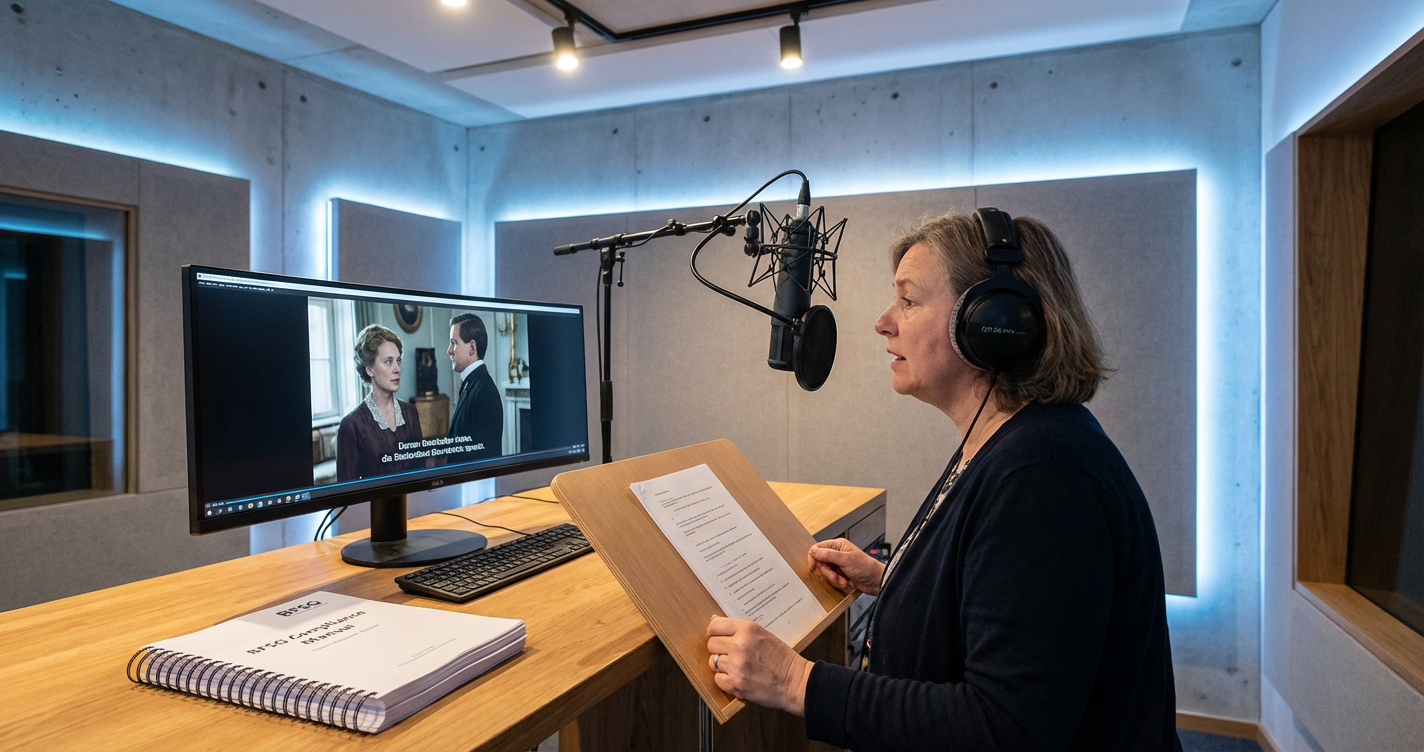
French audiodescription is treated as a creative act, not merely technical work. The CSA/Arcom quality guide establishes that the narrator’s voice must be present yet discreet, integrated into the film’s sound universe, respecting dialogue, sound effects, silences, and music. The cultural expectation is that AD conveys the filmmaker’s artistic intentions.
The exception culturelle philosophy creates institutional resistance to purely automated or commodified approaches to AD. Quality is measured not just by accuracy but by literary merit.
French-Language Challenges
- Grammatical gender: Every noun is masculine or feminine. Audio describers must make gender choices that can inadvertently reveal plot points or introduce bias. The debate around écriture inclusive adds complexity.
- Language registers: French has distinct formal (soutenu), standard (courant), and familiar (familier) registers. AD narration must match the register of the work. A banlieue film requires different vocabulary than a period costume drama.
- Vouvoiement/tutoiement: The vous/tu distinction carries relational and social meaning that the narrator’s voice must respect.
- Temporal complexity: French verb tenses (passé simple, plus-que-parfait) and complex sentence structures must be navigated carefully for clarity in rapid delivery.
The Francophone Market
French AD professionals serve three markets: France, Belgium, and Switzerland. The EAA applies to France and Belgium (both EU members), and co-productions between the three countries benefit from shared AD resources. Belgium’s RTBF dedicates approximately EUR 1.6M to audiodescription annually and became the first Belgian broadcaster to offer audio-described advertising. Switzerland’s RTS produces AD for magazines, Swiss films, and documentaries.
Where AI Fits In
The CNC/BearingPoint Study
A major study published in April 2024 examined AI usage across cinema, audiovisual, and gaming sectors. The key finding for audio description: AI tools provide significant time savings and could increase the volume of accessible works, but current technology lacks nuance for understanding the intentions behind gestures, facial expressions, and artistic choices. AI cannot replace the work of interpretation of original text and images.
Senate Attention
In March 2024, Senator Bruno Belin formally questioned the Minister of Culture about AI’s impact on French audiodescription, raising concerns about replacement of professionals, scraping of creative works, consent requirements, and audience transparency about synthetic content.
The French Startup Landscape
Sibylia, founded by David Rodriguez, offers an AI-powered platform that generates audio descriptions from video content. DescribePro (reported August 2025) uses a hybrid model where AI generates drafts that human authors refine. Visonic AI, which supports French-language AD output alongside English, German, and Hindi, uses multimodal AI to understand long-form video contextually, generating descriptions that respect narrative structure rather than just labelling objects frame by frame.
The institutional sentiment in France is cautious: AI as a tool to assist, not replace. France’s cultural protectionism and the literary status of AD work create barriers to full automation that don’t exist in more pragmatic markets like Germany (where half of public broadcasters already use AI voices) or the US (where 3Play Media offers AI-hybrid AD at $7.50/min). Human creativity and cultural interpretation remain central to how France defines quality audiodescription.
For a deeper look at the technology, see our complete guide to AI for audio description.
What’s Coming Next
- EAA enforcement: The June 2025 effective date means Arcom has expanded authority over accessibility compliance. Sanctions of EUR 100,000 per violation.
- SMAD decree evolution: Arcom’s December 2025 advisory signals continued tightening of streaming platform obligations.
- Government AD portal expansion: The Ministry of Culture’s portal already catalogues 2,500+ films. Partner platforms include Arte.tv, france.tv, TF1+, Canal+, LaCinetek, and Orange VOD.
- Marius de l’audiodescription: Continuing to raise the profession’s visibility and cultural prestige.
- AD in advertising: Following France Télévisions and M6, expect other broadcasters and advertisers to integrate AD into commercial content.
Getting Started
- Assess your profile: Onisep recommends a literary or linguistic background. Strong written French is essential.
- Choose a training path: IMDA, Ecole TITRA, INA, or the Université de Strasbourg Master’s depending on your career stage and funding eligibility (CPF, AFDAS).
- Study the Arcom quality guide: The 2020 guide defines professional standards for French AD.
- Build a diverse client base: Cinema, TV, theatre, museums, live events. Specialisation is a luxury for later.
- Connect with the community: Association Française d’Audiodescription, apiDV, Ciné-Sens.
- Explore AI tools: Try Visonic AI to see how hybrid workflows can increase your output while preserving your creative voice. Upload a video and review what the AI generates in French.
Ready to see how AI augments professional audio description?
- Explore our products: See how Visonic AI handles audio description, auto-summarisation, and auto-shorts
- Get started with Visonic AI: Sign in and upload your video to experience AI-powered audio description
- Contact our team: Discuss how AI tools can scale your audiodescription practice