· Ari Surana · Industry · 9 min read
Audiodeskription in Germany: DACH Career Guide 2026
How to become an Audiodeskriptor in Germany: training at the Hörfilmakademie, BFSG/EAA compliance, broadcaster demand, rates, and why half of public broadcasters already use AI voices.
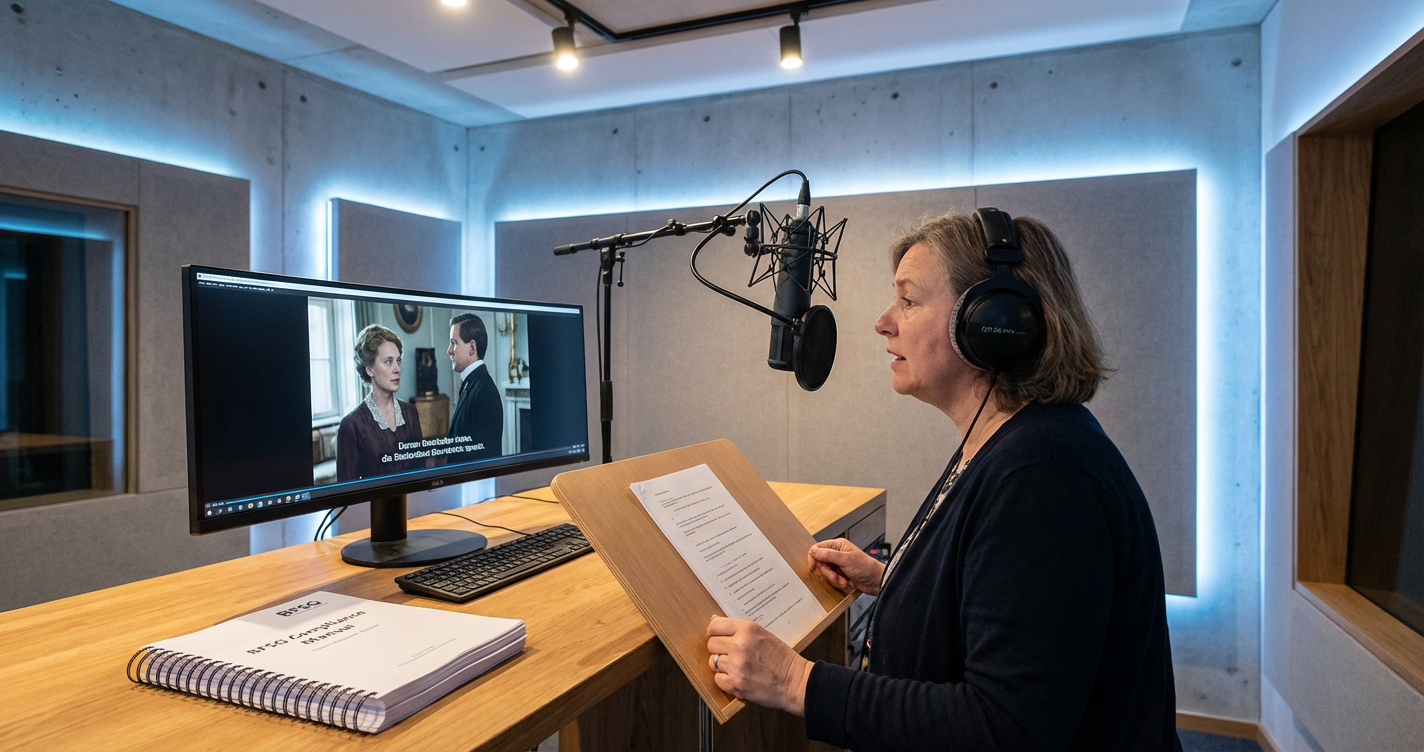
ZDF audio describes 99.5% of its primetime fiction. Half of Germany’s public broadcasters now use synthetic AI voices for audio description production. And yet only 4% of all German television has Audiodeskription.
That 4% figure, reported under Medienstaatsvertrag obligations, represents one of the largest supply gaps in European media accessibility. Germany pioneered audio description on the continent (the first audio-described film in 1989, the first TV broadcast on ZDF in 1993, the first dedicated broadcaster department at Bayerischer Rundfunk in 1997), but three decades later, the vast majority of programming remains inaccessible to blind and visually impaired viewers.
The BFSG (Barrierefreiheitsstärkungsgesetz), Germany’s transposition of the European Accessibility Act, took effect on June 28, 2025, with fines up to EUR 100,000. The Medienstaatsvertrag keeps tightening. The Filmförderungsgesetz mandates AD for all publicly funded films. Demand for skilled Audiodeskriptoren is growing faster than training programmes can produce them, which is exactly why AI tools like Visonic AI are entering the workflow, generating draft descriptions that human professionals then review and refine.
The Regulatory Landscape
BFSG / European Accessibility Act
The BFSG requires products and services to be accessible: “findable, accessible, and usable” for people with disabilities “in the usual manner, without particular difficulty and in principle without external assistance.” The two-sense principle mandates alternative formats: text, images, video, or audio.
The scope covers ATMs, ticketing machines, e-commerce, digital services including banking and media. Non-compliance carries fines up to EUR 100,000, with the Bundesfachstelle Barrierefreiheit overseeing enforcement. Some services have a transition period until June 2030.
For the audio description industry, the BFSG creates legal obligations beyond broadcasting. Any digital media service accessible to German consumers needs to consider accessibility.
Medienstaatsvertrag
The Interstate Media Treaty governs broadcaster obligations and requires progressive expansion of accessible content. Broadcasters must report on accessibility efforts every three years. The 5th, 6th, and 7th amendments entered force between October 2024 and December 2025, each tightening requirements.
Disability organisations including DBSV have criticised the treaty for not going far enough. The 4% AD coverage figure illustrates the gap between aspiration and reality.
Filmförderungsgesetz (FFG)
Since 2013, all films receiving production or distribution support from the FFA or DFFF must include German audio description and subtitles for hearing-impaired audiences, ready by theatrical release. The FFA supports cinema accessibility investments at 50% as grants. This means every publicly funded German film requires AD, creating steady production demand.
Key Organisations
DBSV and the Deutscher Hörfilmpreis
The Deutscher Blinden- und Sehbehindertenverband organises the annual Deutscher Hörfilmpreis, now in its 24th year (2026 ceremony: March 24, Berlin). The prize has become the primary recognition for audio description excellence in the German-speaking world, with 20 productions nominated across six categories in 2026: cinema films, TV/streaming films, series, documentaries, children’s and youth films, and film heritage.
DBSV founded the “Hörfilm” project in 1998, which evolved into Deutsche Hörfilm gGmbH (DHG) in 2001.
Deutsche Hörfilm gGmbH (DHG)
Based in Berlin, DHG has been producing audio description since 1999. A non-profit company created from DBSV’s audio description efforts, DHG produces AD for film, TV, festivals, exhibitions, stage, and cultural events. They work with ZDF, the Berlinale, and State Museums Berlin.
Hörfilm e.V.
The professional association of film describers, both sighted and blind, has been active for over 15 years. They maintain the primary audio description database for the entire German-speaking region (hoerfilmev.de) and publish recommended minimum rates for theatre AD work.
audioskript GmbH
Active since 2012, audioskript produces approximately 350 AD productions per year, working to quality standards developed jointly by ARD, ZDF, SRF, and ORF. Multiple Deutscher Hörfilmpreis winners. They helped develop the shared quality standards used across the DACH region.
Bayerischer Rundfunk (BR)
BR houses Germany’s first dedicated Hörfilm editorial department, established in 1997 by Bernd Benecke, who started working with AD in 1989 and became Germany’s first full-time Hörfilm editor. Benecke’s academic work on audio description as “partial translation” provides the theoretical framework that still shapes German AD practice.
How to Become an Audiodeskriptor
There is no single standardised national certification for Audiodeskriptoren in Germany. Training is delivered through a mix of academies, university programmes, and workshops.
Hörfilmakademie
The Hörfilmakademie is the primary dedicated training programme:
- Regular duration: 8.5 months (including summer break and final exam), approximately 15 hours per week
- Accelerated duration: 5.5 months (without summer break), approximately 15 hours per week
- Format: Two in-person blocks in Berlin plus input videos, online workshops, group and individual coaching, text work with blind and sighted colleagues, and independent project work
- Curriculum: Sensitisation on blindness and visual impairment, AD software (“Frazier”), describing series (including glossary creation), describing documentaries
- Instructors: Experienced sighted and blind AD authors
Un-Label (Cologne)
Un-Label focuses on performing arts AD. Their advanced training runs as a team programme: one blind or visually impaired author paired with two sighted authors. The October 2025 to March 2026 programme includes a 3-day intensive plus editorial support, live testing, and feedback. Costs: EUR 460-1,040 plus VAT depending on employment status.
SDI München
Workshops with Dr. Bernd Benecke covering AD history, national and international guidelines, and technical aspects across cinema, DVD, TV, and theatre. Compact 2-day format, practice-oriented.
University Programmes
HAW Würzburg-Schweinfurt offers a Master’s in “Fach- und Medienübersetzen” that covers audiovisual translation including audio description. AD is typically taught as a module within broader AVÜ (audiovisual translation) programmes rather than as a standalone degree.
Rates and Pay
Unlike many countries where AD pay data is opaque, Germany has some published figures:
Employed Audiodeskriptor/in
- Average annual salary: EUR 54,108
- Entry-level: From EUR 41,532 per year
- Maximum: Up to EUR 71,796 per year
- Monthly median: Approximately EUR 4,509 gross
- Hourly equivalent (40-hour week): Approximately EUR 26.01 gross
Freelance and Theatre Rates (Minimum Recommendations)
Hörfilm e.V. publishes minimum rate recommendations:
- AD author/editor (theatre): Minimum EUR 250 per day per person (includes viewing, live testing, correction, conception of introduction and tactile tour)
- Speaker for live AD: Minimum EUR 310 per performance (higher for longer productions)
Employment Structure
Most Audiodeskriptoren work freelance (freiberuflich). Some are employed by broadcasters, notably BR’s Hörfilm editorial department. Work is project-based, and teams typically consist of sighted and blind or visually impaired authors working together, a distinctive feature of German AD practice.
What Makes German AD Distinctive
The Hörfilm Tradition
Germany treats audio description as a literary and creative discipline, not merely technical accessibility. Bernd Benecke’s doctoral thesis frames AD as “partial translation,” a concept that positions the audio describer as an author making creative choices, not a technician following rules.
The Deutscher Hörfilmpreis reinforces this. With 24 years of history and six categories, it recognises AD as craft worthy of public celebration alongside the films themselves.
German-Language Challenges
German presents specific challenges for audio description:
- Compound words (Komposita): German creates long compound words that consume more syllable space in dialogue pauses than equivalent English descriptions. Conciseness requires particular skill.
- Sentence structure: German verb-final constructions in subordinate clauses create pacing challenges. Longer average sentence lengths compared to English demand careful word economy.
- Register (Siezen/Duzen): The formal/informal address distinction carries social meaning. AD scripts must match the register of the content.
- Gendered language (Gendern): The ongoing debate around gender-inclusive language (e.g., Audiodeskriptor:in with the Genderdoppelpunkt) adds complexity to professional terminology and AD scripting.
The DACH Market
Germany, Austria, and Switzerland operate as effectively one market for audio description:
- Shared quality standards: audioskript works to standards developed jointly by ARD, ZDF, SRF (Switzerland), and ORF (Austria).
- Shared database: Hörfilm e.V. serves the entire German-speaking region.
- Austria: ORF delivered 3,120 hours of AD in 2024, with a target of 3,896 hours by 2027.
- Switzerland: SRG produced 1,846 broadcast hours of AD in 2024.
- Cross-border channel: 3sat (joint ZDF, ORF, SRF, ARD channel) serves all three markets.
- Austrian and Swiss describers can access German training programmes.
AI Adoption: Already in Production
Germany is ahead of most countries on AI adoption in audio description. Half of German public broadcasters now use synthetic or AI voices for AD production:
| Broadcaster | AI Usage |
|---|---|
| ZDF | AI-optimised synthetic voice for “Terra X” (since April 2024) and youth series “Echt” |
| MDR | Synthetic/AI voices for AD |
| WDR | Synthetic/AI voices for AD |
| NDR | Synthetic/AI voices for AD |
| Radio Bremen | Synthetic/AI voices for AD |
Broadcasters cite time savings, ability to describe more content including time-sensitive broadcasts completed shortly before airing, and increased total volume of AD-available programming.
The Debate
The conversation is more nuanced than “AI good” or “AI bad”:
- DBSV’s position: Doesn’t categorically reject AI voices but considers them suitable only for certain documentary formats, not fiction. The emotional and cultural dimensions of fictional content still require human narration.
- ver.di (the media union) has flagged concerns about job displacement.
- Professional speakers argue that human voices convey emotional tone more effectively, especially for fictional content.
- ARD and ZDF have established principles to make AI usage transparent to audiences.
For a deeper look at the technology, see our complete guide to AI for audio description.
The practical reality: AI voices for documentary content are already normalised in German broadcasting. For fiction, human voices remain the standard. The hybrid model (AI for drafting and technical work, humans for creative judgment and narration of emotional content) is becoming the working consensus. Platforms like Visonic AI support this model directly: they generate contextually aware AD scripts from video content in multiple languages including German, so Audiodeskriptoren can focus their time on creative refinement rather than starting from a blank page.
What’s Coming Next
- BFSG enforcement intensifies: The June 2025 effective date means compliance audits are underway. Digital media services face real fines for the first time.
- Medienstaatsvertrag evolution: The 6th and 7th amendments (December 2025) tighten progressive accessibility requirements for broadcasters.
- Streaming platform expansion: Netflix, Disney+, and Amazon Prime Video all offer German-language AD tracks and are expanding their catalogues.
- 24th Deutscher Hörfilmpreis: March 24, 2026, in Berlin. Twenty productions across six categories.
- Training innovation: The Hörfilmakademie and Un-Label are producing new cohorts of trained describers, but not fast enough to close the 96% gap.
The math is straightforward: 4% of German television has audio description. The legal requirements are expanding. The workforce isn’t growing fast enough. For people entering the profession, this is an opportunity.
For perspective on how other markets are evolving, see our career guides for the UK (the most mature AD market in the English-speaking world), France (where the literary tradition of audiodescription shapes a distinctive approach), and the US (heading into its biggest demand surge with the ADA Title II deadline).
Getting Started
- Explore training: Hörfilmakademie for the most comprehensive programme (5.5-8.5 months). Un-Label for performing arts focus.
- Study the craft: Read Bernd Benecke’s work on AD as partial translation. Attend SDI München workshops.
- Join the community: Hörfilm e.V. for the professional network and describer database. AVÜ e.V. for the broader audiovisual translation community.
- Attend the Hörfilmpreis: March 24, 2026, in Berlin. The annual gathering of the German AD community.
- Consider the DACH market: Your skills serve Germany, Austria, and Switzerland.
- Explore AI tools: Try Visonic AI to experience the hybrid workflows that broadcasters are already adopting. Upload a video and see AI-generated Audiodeskription in action.
Ready to see how AI augments professional audio description?
- Explore our products: See how Visonic AI handles audio description, auto-summarisation, and auto-shorts
- Get started with Visonic AI: Sign in and upload your video to experience AI-powered audio description
- Contact our team: Discuss how AI tools can scale your Audiodeskription practice