· Visonic AI Insights Team · Industry · 7 min read
Scaling Global Video: Ending the Localization Tax with AI
A cost-benefit guide for media teams scaling audio description across global video libraries, from manual localization costs to AI-assisted OpEx and build-vs-buy tradeoffs.
Global video distribution has a hidden tax.
Every time a media company expands into another market, accessibility has to expand with it. Audio description cannot stay in one language if the audience, regulator, distributor, or platform requirement is local. The traditional answer is to run a new production workflow for every language: new script, new voice, new mix, new quality review, new delivery package.
That is the localization tax.
For small volumes, teams absorb it as a project cost. For a broadcaster, OTT platform, localization agency, university, or enterprise media library with hundreds or thousands of hours of video, the math breaks quickly.
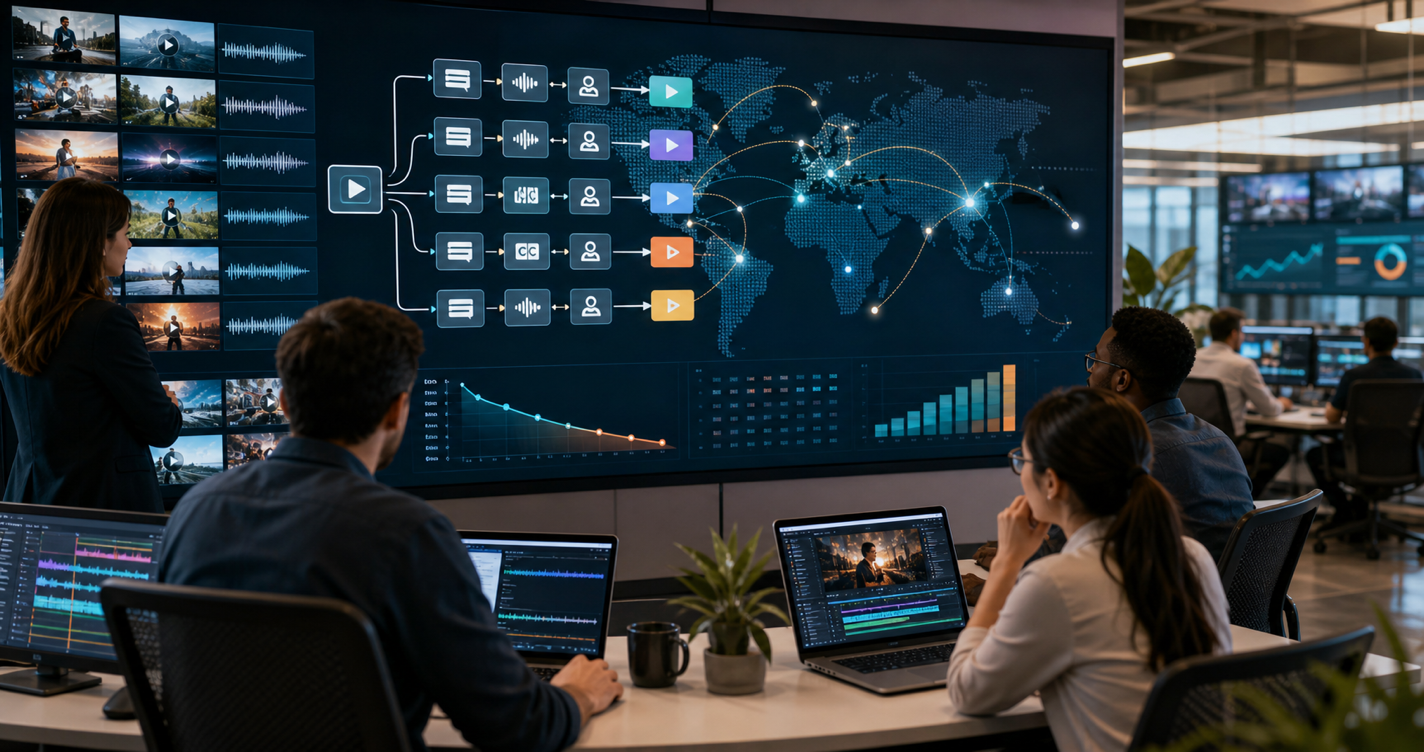
AI does not remove the need for quality standards. It changes the unit economics. Instead of rebuilding the whole process for every market, an AI-assisted workflow can analyze the video once, generate timed description outputs in multiple languages, and reserve human review for the places where judgment matters most.
This guide breaks down the cost model, the build-vs-buy decision, and the operational reasons global video accessibility is moving from manual project work to automated infrastructure.
The Market Shift: Compliance Is Now an Operating Problem
Video accessibility is no longer a nice-to-have feature buried in a roadmap.
The regulatory direction is clear:
- The U.S. Department of Justice’s ADA Title II web rule ties state and local government web and mobile accessibility to WCAG 2.1 Level AA requirements.
- The European Accessibility Act has applied across EU member states since 28 June 2025.
- India’s Ministry of Information and Broadcasting has published OTT accessibility guidelines for platforms serving people with hearing and visual impairments.
The business question is no longer only “Do we need audio description?”
It is:
- How much of the library needs coverage?
- Which markets and languages matter first?
- How fast does new content need to launch?
- What should be reviewed by humans?
- How do we avoid building a new manual bottleneck inside every region?
For global media teams, accessibility is now a unit economics problem.
What Actually Drives Audio Description Cost?
Traditional audio description cost is not one line item. It is a stack of labor, coordination, and production work.
The biggest drivers are:
- Content density: fast action, visual comedy, complex drama, graphics-heavy education, and sports all require more careful description choices.
- Spotting and timing: every description must fit around dialogue, music, and important sound.
- Scriptwriting: skilled describers decide what matters and what should be omitted.
- Voice and mixing: narration must be recorded or synthesized, balanced, exported, and checked.
- Quality review: timing, accuracy, tone, terminology, and delivery files all need QA.
- Language multiplication: every additional language repeats much of the same workflow.
That last point is the localization tax. Traditional audio description scales roughly linearly with language count.
One language is expensive. Five languages can become a separate production budget.
For a deeper per-minute comparison, see our guide to the true cost of audio description.
Scenario: A 1,000-Hour Back Catalog
Consider an OTT platform with a 1,000-hour back catalog that needs audio description.
That is 60,000 finished minutes.
If the blended manual production rate is $25 per finished minute, a single-language rollout is already a $1.5 million project before internal coordination costs.
| Metric | Traditional Workflow | AI-Assisted Workflow |
|---|---|---|
| Source library | 1,000 hours | 1,000 hours |
| Planning unit | Finished minute per language | Source video plus target outputs |
| Single-language budget exposure | $1.5M at $25/min | Platform usage plus targeted review |
| Three-language expansion | Often approaches 3x production cost | Additional languages add marginal workflow cost |
| Time to first usable draft | Weeks or months across batches | Hours or days across batches |
| Main constraint | Human production capacity | Review policy, QA standard, and delivery priority |
The numbers vary by content type, provider, review model, and voice requirement. But the shape of the model stays the same: manual localization multiplies cost by language, while AI-assisted workflows reduce the repeated setup and drafting burden.
That matters because a 1,000-hour library is not unusual. Many streaming platforms, broadcasters, universities, government agencies, and enterprise learning teams have far more.
The Multi-Language Cost Curve
Manual workflows treat each language as a new project.
AI-assisted workflows should treat language as an output configuration built from a shared video understanding layer.
That does not mean translation alone is enough. Good audio description has to be natural in the target language. It also has to respect timing, culture, idiom, and viewer expectation.
But the workflow changes:
- The video is analyzed once for scene structure, characters, visual action, and dialogue gaps.
- The system builds timed description candidates from that understanding.
- Language-specific versions are generated from the same underlying context.
- Human reviewers focus on quality, style, and market-specific decisions.
This is why multi-language AI audio description is not only a pricing feature. It is an operating model.
For more detail, read Multi-Language Audio Description: Global Scale.
The Build-vs-Buy Trap
Some teams look at the cost of localization and decide to build their own AI pipeline.
For a few companies, that can make sense. If your core business is building video AI infrastructure and you have the team to maintain it for years, internal development may be strategically justified.
For most media companies, it is a distraction.
The hard part is not calling a model. The hard part is making the workflow dependable enough for production:
- long-form video understanding
- dialogue-gap detection and timing logic
- density controls
- multi-language generation
- voice output
- file exports
- review workflows
- QA tooling
- security and retention controls
- API and content pipeline integration
- monitoring, retries, and support
- continuous model evaluation as content changes
| Cost Area | In-House Build | Purpose-Built Platform |
|---|---|---|
| Initial engineering | Product, ML, backend, media, and QA teams | Already built into the platform |
| Time to production | Often months before reliable output | Immediate pilot, then scale |
| Ongoing model work | Continuous evaluation and improvement | Vendor roadmap and product maintenance |
| Security review | Your team owns the full surface area | Vendor documentation and platform controls |
| Workflow fit | Custom, but expensive to maintain | API and self-serve workflows designed for media operations |
| Opportunity cost | Engineers diverted from core product | Accessibility workflow handled as infrastructure |
The build decision should be judged against the full five-year ownership cost, not the first prototype.
If the goal is to scale accessible output quickly, buying a specialist platform is usually the more practical path.
Security and Integration Matter as Much as Price
Global video accessibility often touches unreleased episodes, licensed masters, educational content, government media, or confidential enterprise training.
The vendor question is not only “How much does it cost?”
It is also:
- Where does the media go?
- Who can access it?
- Is content encrypted in transit and at rest?
- How long is uploaded media retained?
- Can the workflow fit existing MAM, DAM, CMS, or content operations systems?
- Can generation be triggered automatically when content enters the pipeline?
Visonic AI is designed around secure, automated processing and clear content handling. Our privacy policy explains how uploaded videos are stored temporarily for processing, and our security overview explains why broadcasters trust Visonic AI with pre-release content.
For enterprise teams, this is where AI-assisted accessibility becomes operational. The goal is not a standalone demo. The goal is a repeatable pipeline.
The ROI of Speed
Cost reduction is only one side of the business case.
Speed changes what becomes possible:
- day-and-date accessible releases across multiple territories
- faster remediation of older catalogs
- shorter procurement and vendor coordination cycles
- more titles available for licensing
- fewer release delays caused by accessibility production
- improved support for eyes-free viewing, multitasking, education, and low-vision audiences
When manual audio description takes weeks, accessibility becomes something teams schedule around. When automated workflows produce usable drafts quickly, accessibility can become part of the normal release process.
That is the real business shift.
A Practical Decision Framework
If you are evaluating global audio description at scale, start with five questions.
- How many finished hours need coverage? Separate new releases from back catalog.
- How many languages matter in the next 12 months? Include regulatory markets and commercial growth markets.
- Which titles need human review? Define tiers instead of applying the same review depth to everything.
- What systems need integration? Identify MAM, DAM, CMS, storage, QA, and delivery dependencies early.
- What is the cost of delay? Include missed launch windows, manual vendor coordination, and unserved audiences.
This turns accessibility from a vague compliance spend into a measurable operating plan.
The Bottom Line
The localization tax exists because traditional audio description treats every language and every title as a fresh manual project.
AI changes that.
By analyzing video once, generating timed outputs across languages, and routing human expertise to review and QA, media teams can make global accessibility economically practical. The result is not lower standards. It is a better cost curve for reaching more viewers.
If your team is planning a multi-language rollout or trying to model the economics of a large library, contact Visonic AI. We can help you map the cost, timing, and workflow tradeoffs against your actual content pipeline.